Best of Both Words is a newsletter for language workers, community organizations, neighbors, and kinfolk about the evolving landscape of language justice. It’s an act of refusing binary, either/or thinking when it comes to language and the social relations that languages express. Best of Both Words is an engagement with the ways that this world is in dire need of language justice, and the ways that people are fighting to build it.
The first political event I ever went to was a showing of the documentary Gaza Strip in 2003. At the time, I knew nothing of Gaza, Palestine, or of the Second Intifada. That event changed the trajectory of my life. It called into question all the one-sided history about the Middle East that I was taught in school; it shed light on my alienation and trauma as a (not-yet-out) queer, mixed-race black woman in this country. The bravery of the Palestinians before, during, and after the Second Intifada was a calling to me to move from being a passive bystander to world events to becoming an active contributor to a wide range of social and political struggles.
Twenty years later, what happens in Palestine still calls me. I know and feel how interconnected Palestinian liberation is to my own as a black person in the US.
For this reason, this month’s newsletter focuses on Palestine. There are many great writers analyzing and detailing Israel’s current genocidal campaign in Gaza (I’m happy to share reading recommendations, just DM or comment below), so instead what follows is a brief summary of themes around language, meanings, and Palestine.
First, language justice is not only a cross-language dynamic. Language justice also compels us to consider the words within a language that we use to talk about people, histories, and events. Deciding whether or not to call something a genocide or a war changes the meaning and perception of ongoing and historical events. Saying that people are dying rather than being murdered blurs the relationship between the actors involved.

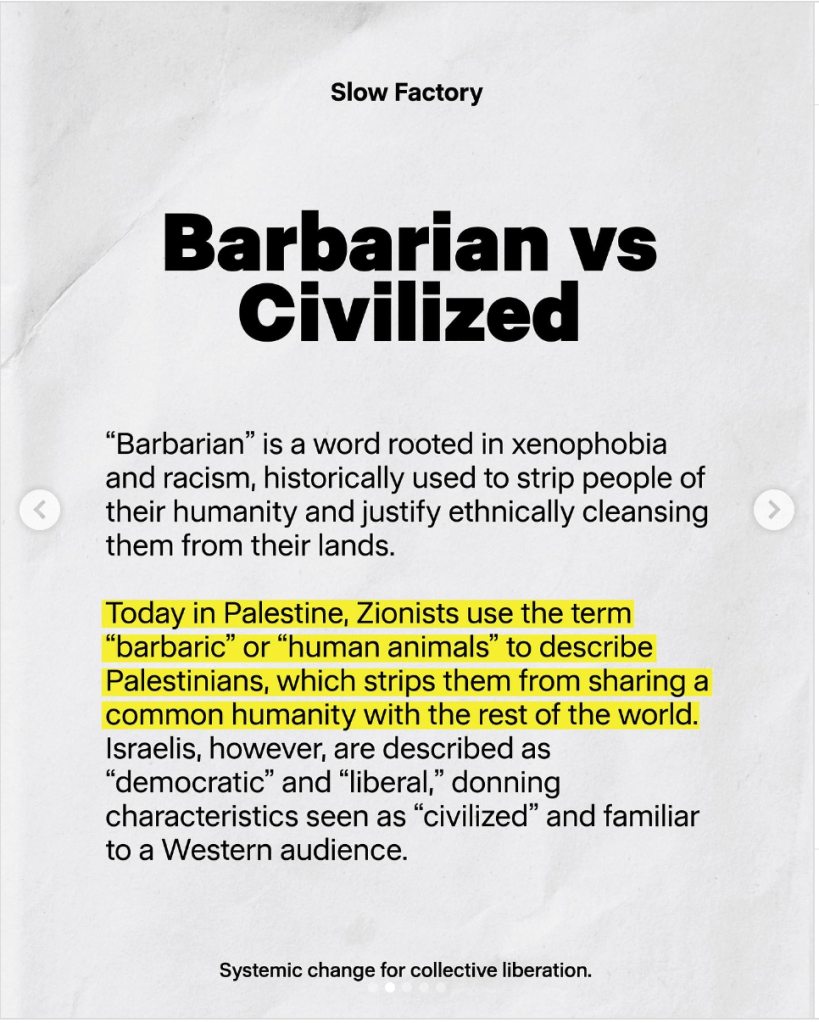


(Images from Slow Factory)
The racist language typically used by the Western media and governments intentionally dehumanizes Palestinians, to the point that many are questioning why they have to beg to be treated as humans.

Second, language justice always matters, but its presence or absence can have especially profound impacts in war zones and border zones (two spaces that are often one and the same).
Access to reliable translation and interpretation services in border zones can mean the difference between life and death, between freedom of movement and incarceration or deportation.
Such services can also affect access to on-the-ground accounts of events unfolding in war/border zones—assuming such voices are even allowed to broadcast and disseminate information, an activity not guaranteed to Palestinian reporters and citizen journalists. When language services can be provided, a language justice framework is even more necessary to ensure that historical and cultural contexts are carefully considered, and that power structures and infrastructures of oppression are understood, so that the resulting communication accurately conveys meanings. Respond Crisis has detailed how Islamophobic and anti-Arab motifs are showing up in translations about Palestine: “Arabic words are regularly mistranslated or misconstrued in English-language media to stereotype and demonize Palestinians, painting them as terrorists and contributing to racist narratives that pro-Palestinian activism is inherently violent or antisemitic.”

Lastly, I cannot conclude without sharing suggestions for translators & interpreters who want to support a free Palestine. You can always find and join a local protest, read about what’s happening so you can have informed conversations with the people around you, or participate in a BDS campaign (Boycott-Divestment-Sanctions) in your hometown. Beyond that, here are a few ideas specifically for putting your language skills to good use in these dark times:
- Amplify Palestinian voices who are letting the world know what is happening to them. Offer free translations for citizen journalists in Gaza and the West Bank or volunteer to translate for an aid organization.
- Amplify Palestinian voices beyond the current genocide. There is a vibrant history of translating Palestinian literature from Arabic into other languages (see, for instance, the Forum of Arabic-Hebrew Translators) and translating works into Arabic that support Palestinian self-determination.
- Research, identify, and submit feedback on mistranslations you find that contribute to the dehumanization and censorship of Palestinian voices. For instance, Meta was recently called out for inserting the word “terrorist” into the profile bios of some Palestinian Instagram users, in what the company says was a bug in their machine translation.
- If you are going to a teach-in, protest, or other event, see if the organizers need assistance with translating materials beforehand or interpreting for speakers during the event.
In other news…
In newsletter news, the December holiday season is my absolute favorite time of year and I love making it a memorable time for my little one. That means you won’t be seeing a newsletter for December. No worries, though, as I’ll be back in the new year to bring you all things language-justice related.
Translation in the spotlight…
‘Silence for the Sake of Gaza’
By Mahmoud Darwish, translated from Arabic by Ibrahim Muhawi
By Taghreed Najjar, translated from Arabic by Elisabeth Jaquette
By Sonia Nimr, translated from Arabic by M. Lynx Qualey
The City and the Writer: In Gaza with Mosab Abu Toha
Mosab Abu Toha talks with Nathalie Handal about hope, reconstruction, and poetry in Gaza.
Would you like to support Best of Both Words?
- Check out the archives for past newsletters.
- Sign up below to receive the newsletter once a month in your email inbox.
- Connect with me on Instagram, Twitter, or LinkedIn.
- I’d love to hear from you! Share stories, news links, etc., about language justice. You can email them to me at lauren@raytranslations.com or comment below.
- Share the love by sending Best of Both Words to your friends and fellow language workers or by reposting it on your social media.

 Lauren Ray
Leave a comment